

Being together, sensing together: on FORUM at the Biennale de la danse de Lyon 2025 ②
A three-part series reflecting on FORUM, a new initiative of the Biennale de la danse de Lyon, through a conversation with Angela Conquet, who served as both co-curator and coordinator.
In Part ②, we listen closely to the forms of commonality that FORUM brought into being, while taking on—rather than smoothing over—the reality of untranslatability. (Read Part ① here.)
■ Curating relationships: between artists, and with audiences
— Five curators and artists from five regions outside Europe participated. How was that collaborative team imagined?
It was Tiago Guedes who invited the five of us as guest curators. There was an affinity and a trust in us, but beyond that, I think he also wanted to open to others decisions about artists. Each curator brings knowledge and experience rooted in the region where they work; trusting that, and sharing decision-making, was part of the point. It was also an attempt to model another way an institution might operate today—without a single “author” or symbolic figure deciding everything.
As the project evolved, I ended up taking on a role closer to that of a coordinator, or of an overarching curator. We realised someone needed to hold the overall project, document it, and make it legible. I speak both French and English, and I also had more time than others; I was often the one keeping records of discussions, so it became a natural evolution.
What mattered most to me was protecting a space where artists could imagine what they wanted to do, in their own ways. I was a rare privilege: receiving all ideas, letting them resonate, and eventually weaving them together thematically. With that privilege came a responsibility to protect the integrity of each idea.
We were not “selling” anything, that is convincing people to come and see a show. Every programme was free, and unpredictable. That singularity had to be embraced by the Biennale, and we also had to communicate this difference to audiences. Good intentions aren’t enough: the words we use, the space that welcomes people, the experiences we offer—if these don’t align, the whole thing can fall apart. It’s like when you invite someone over for dinner—if the food isn’t good, or the atmosphere around the table doesn’t feel right, then it’s just not a nice moment. In that sense, for me, this was an act of hospitality, but also a job that carries strong responsibility.
— So what you were curating, first and foremost, was “relationship.”
Exactly. The project began by connecting and sharing practices amongst the artists. Encounters formed between the invited artists first, and then relationships with audiences emerged afterwards. There were multiple layers of invitation into these relationships.
And there wasn’t an expectation of “changing the world,” or “selling” something. It was more like opening—sensory, bodily—another way of being together. It is intellectual too, but it starts as an invitation that arrives through shared sensing, corporeally. It may not be what we see in general in Europe. With the FORUM, the question was: how can we share the meaning of these different practices? I think that is what this project opened.
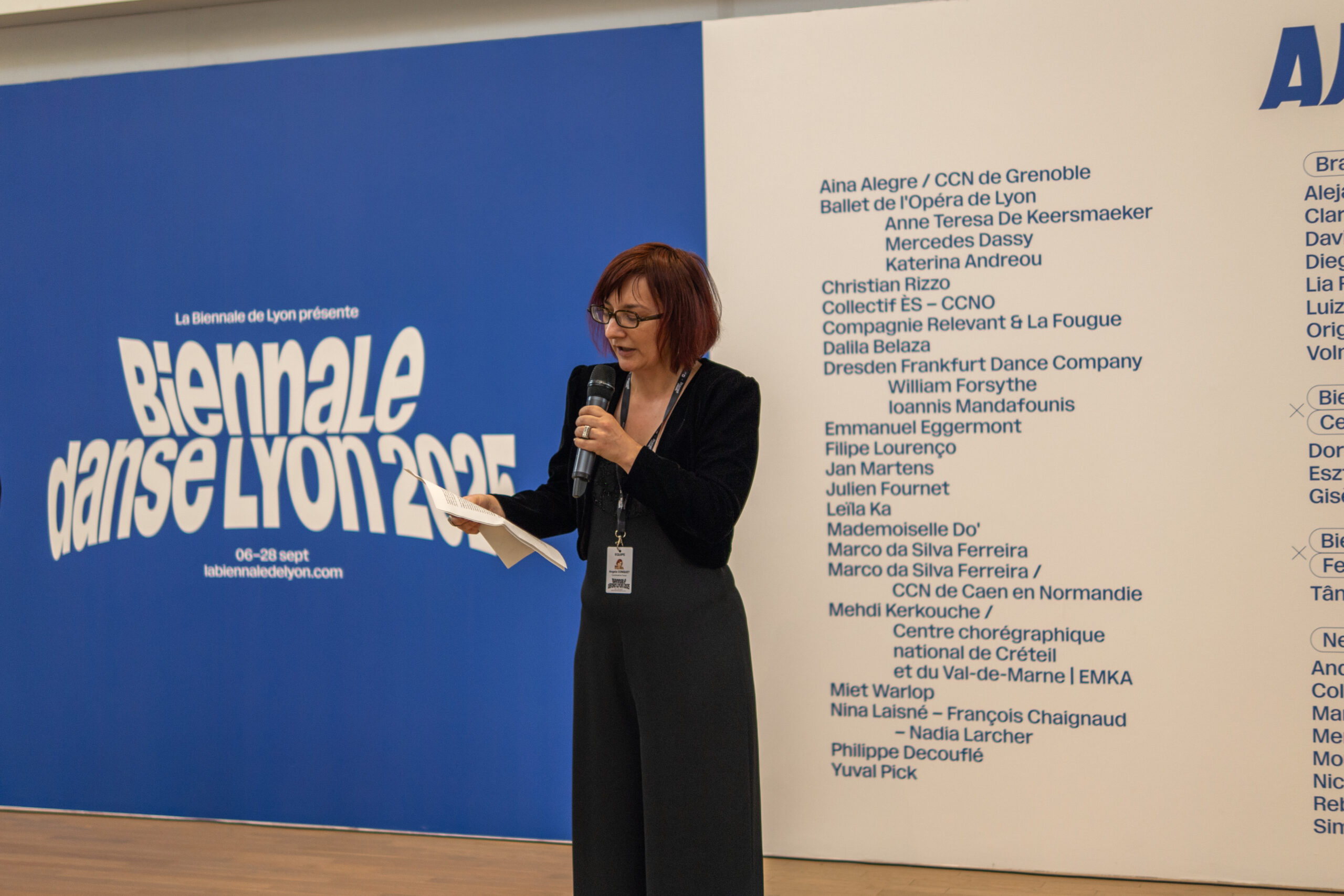
© Elyes Esserhane
■ Language as a mirror of other thought, imagination, and bodily systems
— You were also imagining a space where multiple languages and realities coexist. In a way, that’s political.
Yes—language was crucial. In this space, French, English, and Portuguese coexisted. A young critic wrote something that stayed with me: looking back, these were all historically “languages of colonisers.” Maintaining the possibility of translation in all these languages was therefore necessary from the beginning—if artists were truly to enter dialogue.
For the artists from Mozambique and Brazil, Portuguese was more natural, and we needed to make space to work with it. At the same time, there were moments where translation wasn’t required: when exchange happened through the body. That in itself was deeply suggestive. It forced us to think: at a time when many languages are disappearing, through which languages do knowledge and experience circulate? What does it mean to filter everything only through French, only through English?
I am a trained translator, so in that sense this project was also an intense exercise of translation. For example, the Australian Indigenous company Marrugeku uses the term “(Choreographic) Truth Telling.” It points to a process in which a country or society returns to its past—especially histories of colonisation—recognising what has been told, what has not been told, and taking responsibility for that incompleteness. But French doesn’t have a concept that aligns with this term. Finding a way to translate it—while thinking what it might mean to do “Truth Telling” choreographically—took a long time.
Here we hit a problem: if a word doesn’t exist, it becomes hard not only to understand, to even imagine but also of doing the work. How, then, can we take responsibility? Some expressions or local dialects used by artists carried words that could not be rendered into French or English—almost impossible to translate. They can represent sometimes whole systems of imagination.
There is this Indigenous Australian writer who points out something striking: in English, we say “non-linear time” to describe circular time. But we begin with “non”—a negation. At the very moment we try to imagine another concept of time, we already frame it as a denial of the “normal.”
Language shapes how we speak and how we feel. So this project became an invitation into other ways of thinking, and other bodily sensing. Eco-somatics reminds us that body and environment are intertwined. Like many Indigenous philosophies, it insists that we are not isolated in the universe—we are part of larger systems, responsible to the land we stand on. It is another system of responsibility that many of us have lost. In that sense, FORUM helped us reaffirm something very basic.
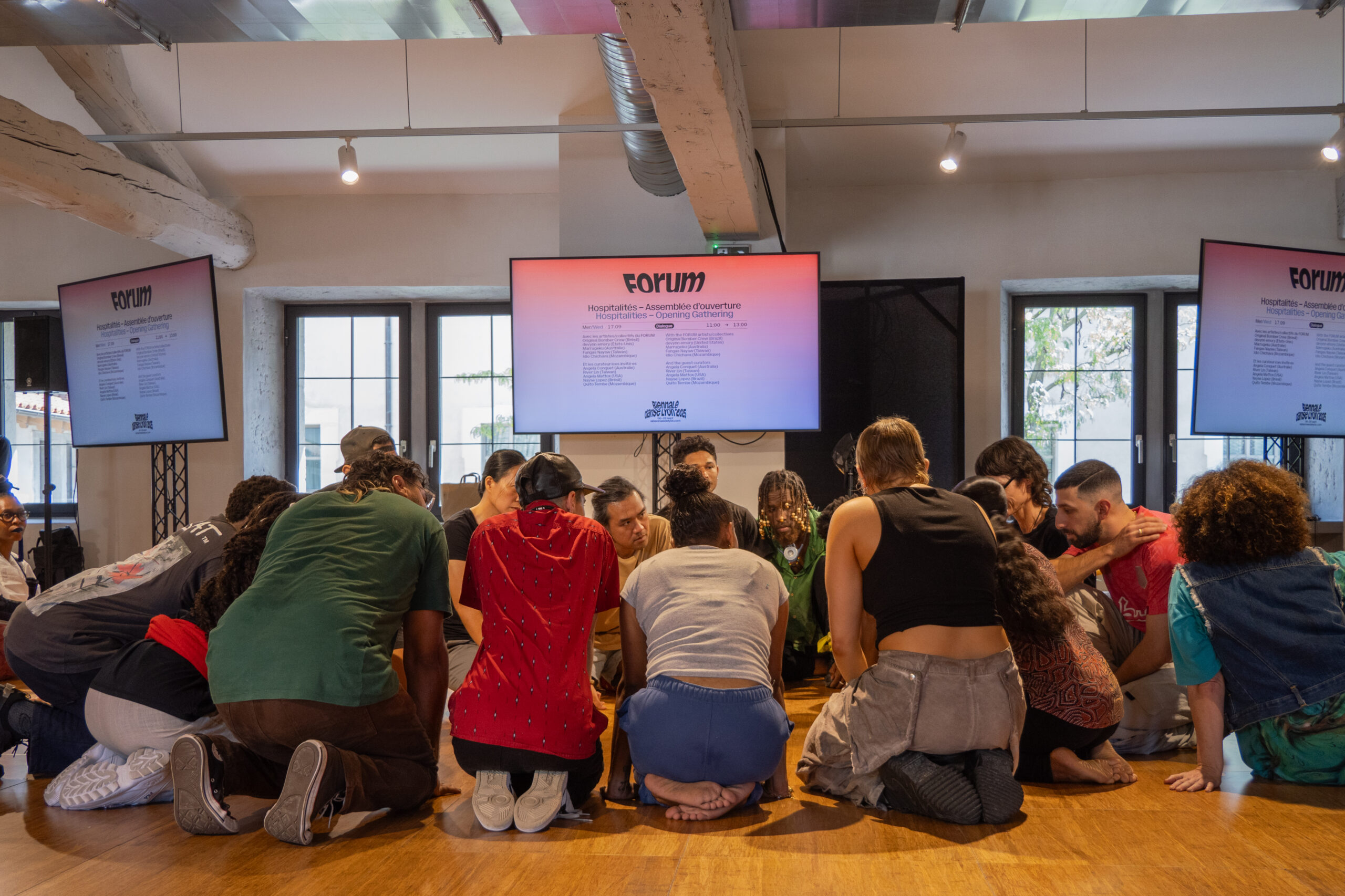
© Elyes Esserhane
■ An opening where “sensing together” emerged
I was only able to be present for one of the five days—yet the experience was intense. The Opening Gathering, placed at the very beginning, showed what FORUM valued and what kind of attitude it attempted to bring into being—before words, through gesture and behaviour.
Artists from the five regions moderated the space like a relay. There was no clear boundary separating performer and audience, host and guest. Seats were arranged in a circle: an intimate shared sphere formed, then bodies suddenly appeared running boldly around its perimeter. The organisation of space never fixed; it kept shifting, rewriting itself.
Each practice carried deeply local colour, rooted in language, history, land. Yet through experiencing them together, something began to rise—not as mere difference, but as a sensory possibility of sharing. Coexistence and resonance among different practices. No one was forced to “represent” a region too neatly; no one was trapped into an over-segregated “minority” frame. And yet nothing was flattened into sameness either. It felt like a loose solidarity, emerging through mutual action while remaining irreducibly plural.
— In Lyon, how much time did you actually spend together?
We were together for a little over a week. But there was a plan we had imagined at the beginning and couldn’t realise: a nomadic form, where artists would visit each other’s places and host one another. Because “hosting / welcoming” was central to the project, we originally imagined them hosting each other in their respective countries or regions.
In reality, distances were too far, and it required too much money and time. More than that, it was difficult to explain to funders: artists meet, something might happen—but we don’t know what. It is not easy to ask institutions to accept that uncertainty.
So prior exchanges happened online, and everyone gathered in the same physical space only once the Biennale began. What surprised me is how quickly everything moved once we met at the venue—Cité Internationale de la Gastronomie. Perhaps because we already knew each other’s proposals and interests, relationships grew almost organically, corporeally, as if we had known each other for a long time. It was a very beautiful scene.
And then—only two days after everyone gathered—the artists built the opening together. Honestly, no one knew what would happen until the last moment. The only thing we knew was that we needed a circle; we didn’t even know until twenty minutes before starting whether the space could hold all visitors.
Yet the opening ended up embodying exactly what the project sought to illuminate. Practices connected and resonated with each other, and that flow pulled audiences in. Without anyone having to explain, without any formal introductions, everything was already there—because the artists created a time for “being together,” and brought into being a state of “sensing together.” It was close to what French philosopher Jean-Luc Nancy calls être-en-commun—being-in-common.
We were not showing “products” or “outcomes.” The artists shared the ways they practise their practice in daily life and then passed it on to other artists and audiences. That meant the project was also highly unpredictable—what it would look like remained unknown until the moment it happened. And this could happen only because the Biennale team—especially technical and communications staff—accepted to work with this unpredictability, supporting it even with flexibility. In the context of a large, institutionalised festival, that is rare, and it can reinvigorate traditional management structures. And the forum was by no means fragilised because of the ways it chose to unfold in the moment. If anything, it was resilient—continuously co-creating with audiences and artists.
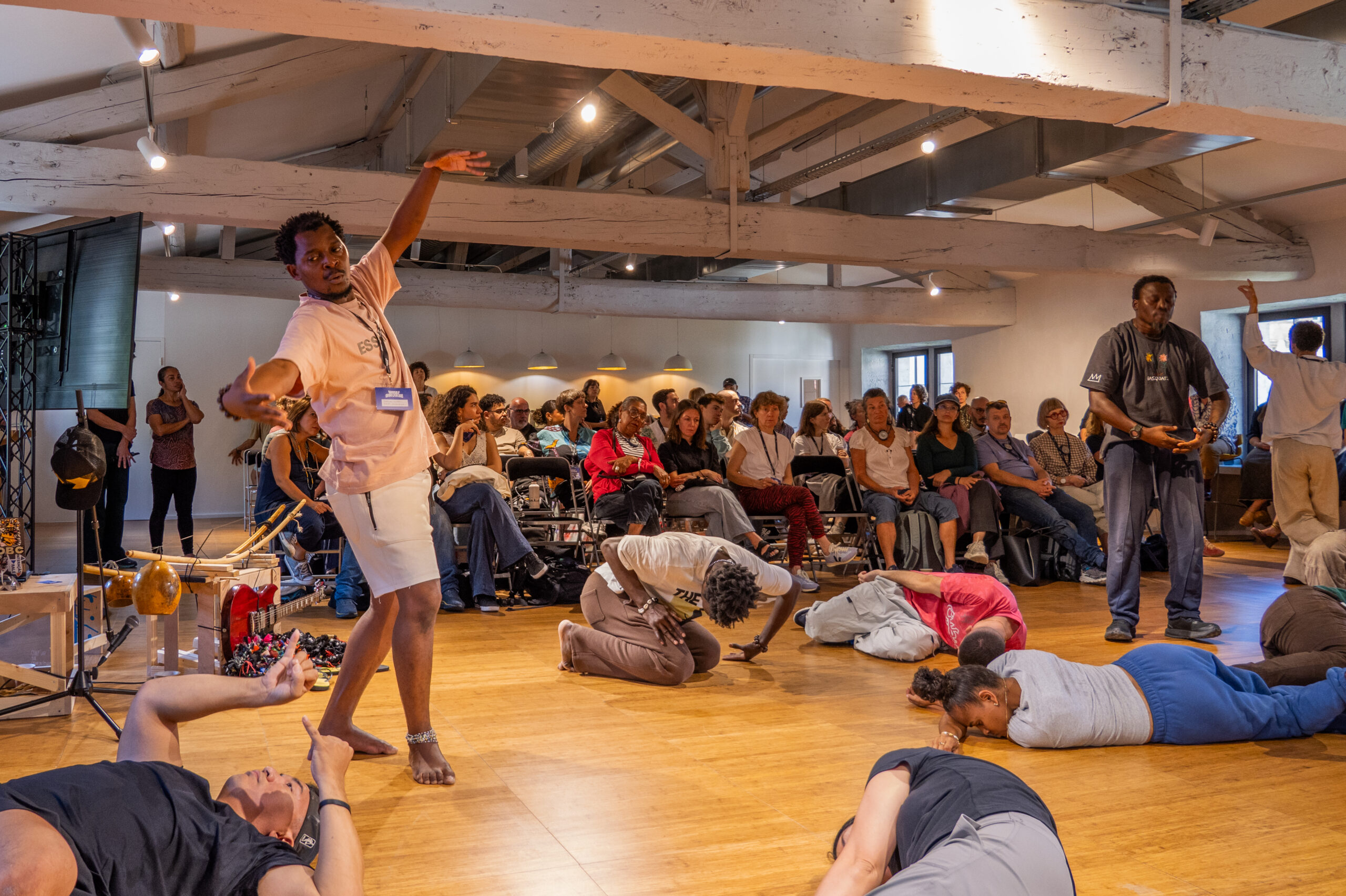
© Elyes Esserhane
— I was deeply impressed. It felt generous, but also radical, unsettling existing formats. If it had begun with a classic keynote, I might have stayed at a safe distance. Instead, “being together” was what rose first, as experience.
There was no intention to “shock” or “provoke.” The format emerged naturally from artists spending time together in the same space. Of course we could have done something classic—like fifteen minutes for each introducing their practice. But they didn’t choose that. Instead, they brought into the opening the methods they use in everyday life: making a circle, sharing knowledge in non-hierarchical ways.
The forms we commonly know as “shows” or “performances” can be considered, in fact, often colonial and exclusionary. There is a stage; audiences sit opposite; doers and viewers are separated; usually a single authorial voice stands in front and is celebrated as such. This spectatorship system developed in Europe and then spread globally. But the artists gathered here practise daily within fundamentally different relations.
That said, it’s not that hierarchy doesn’t exist at all but it is about sharing and transmission of knowledge. For instance, in the communities of Marrugeku in Australia, and Fangas Nayaw in Taiwan, elders or spiritual leaders grant permission and hold responsibility for passing on knowledge. There are aspects you cannot know or speak about you are initiated. In a different context, that’s not so far from the Kabuki world, where without age or experience you cannot perform certain roles.
What I felt strongly is that the opening of the FORUM was not only about this being together (être en commun), but also viscerally, profoundly —almost on the level of viscera—sensing together (sentir en commun).
This format can disorient some people. With pitches, keynotes, discussions, you can anticipate; you can schedule. Here, it was an encounter and a discovery for everyone. People kept asking, “What are we doing?” and I could only answer, “I don’t know—we’ll have to see.” But at a time when we are losing the capacity to wonder, to keep questioning, I think that “not knowing” was precisely what mattered.
In Thomas F. DeFrantz’s workshop, the question “What do you wonder about?” captured that attitude. “Wonder” isn’t about getting answers quickly; it is about continuing to think, pausing, pondering carefully. The answer doesn’t have to arrive today; it may never arrive. And still, you stay with the question. It also offers a permission for thought and body to “wander.”
As a curator, what stayed with me is that the project was never “in our hands” as something completed. Even if there is a brochure or a website, what arrived in this space remained to unfold. In this sense, the project wasn’t the curators’ or even the artists’ property—it was what was co-created together, this delicate yet solid co-togetherness which held an unpredictable strength. If I am to borrow a cooking metaphor (because we were at the Cite de la Gastronomie), it was a little like a mayonnaise: the recipe might look perfect, you have all the ingredients but you don’t know if it will turn out well until you mix it. This time, it came together beautifully.
▶︎ 【Continues in Part ③】
Articles in this series:
Being together, sensing together: on FORUM at the Biennale de la danse de Lyon 2025
Part ①
– Internationality in festivals: between the local and the universal
– Thinking the world through the body: dance beyond “works”
Part ②
– Curating relationships: between artists, and with audiences
– Language as a mirror of other thought, imagination, and bodily systems
– An opening where “sensing together” emerged
Part ③
– Hospitalities: generosity, and the tension it contains
– “What are we calling contemporary dance?”
– Continuing by drawing a spiral: power and responsibility in curation
Interview, Writing & Translation: Yurika Kuremiya
▶︎ 日本語訳はこちらから:
共に在ること、共に感じること —— リヨン・ダンス・ビエンナーレ2025「FORUM」をめぐって
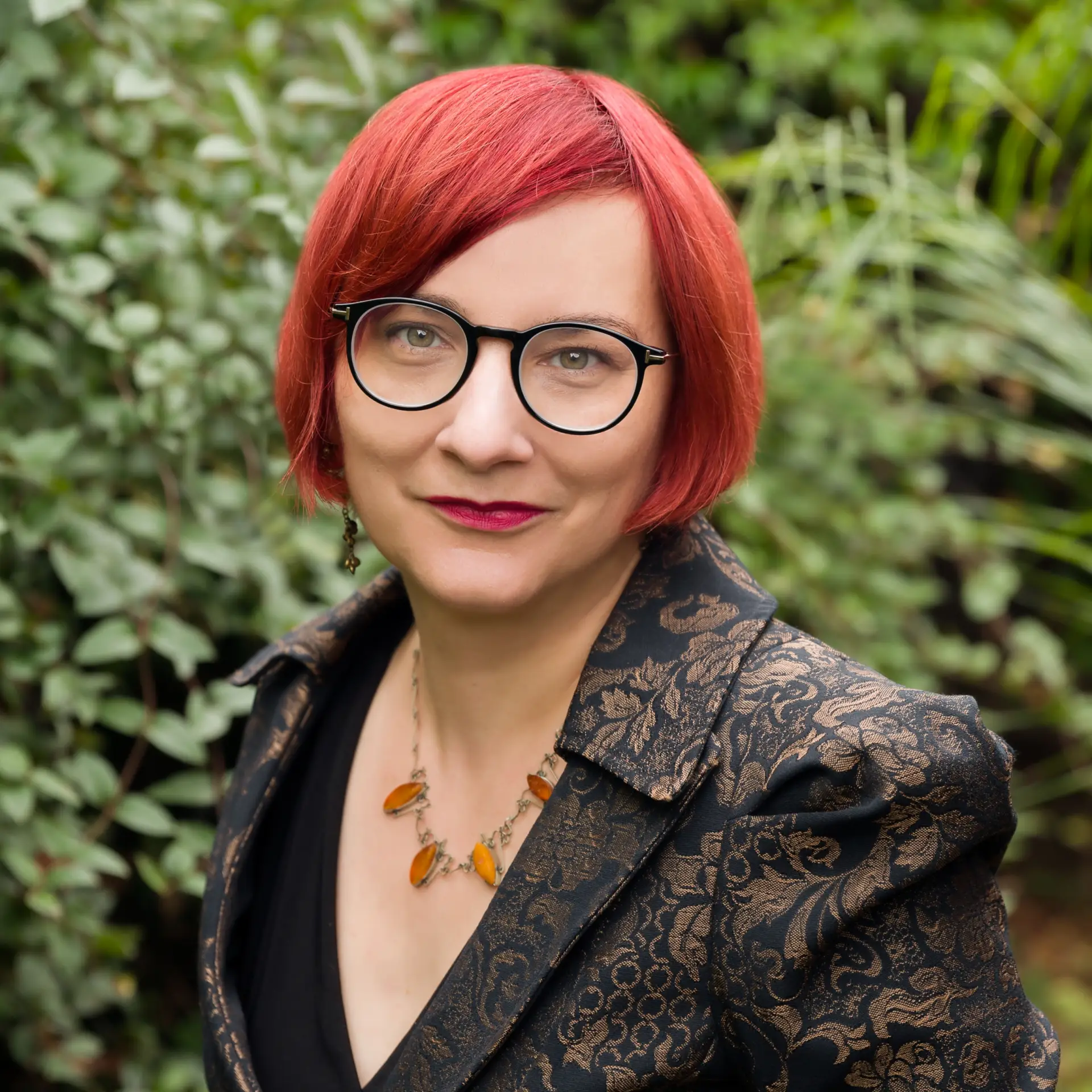 ©︎ Mathilda Parsons
Angela Conquet アンジェラ・コンケ
Angela Conquet アンジェラ・コンケ
Angela Conquet is an independent dance curator, researcher, writer and translator, working between Europe and Australia. She was Artistic Director of Dancehouse in Melbourne from 2011 to 2020 and of the Keir Choreographic Award and co-director of Dance Massive Festival. More recently, she was the Guest Curator of Dance in Vancouver Festival in 2021, a member of the Asia Network for Dance AND+, and a fellow of the Saison Foundation. Before relocating to Australia in 2011, she was leading the dance artist in residence programs at Mains d’oeuvres in Paris. She has just finalised her doctoral thesis at the University of Melbourne/ UGA Grenoble – with a focus on dance-specific curatorial practices – where she also lectures in Arts Management. She is a co-curator and the coordinator of this edition of FORUM at the Biennale de la danse de Lyon 2025.
ヨーロッパとオーストラリアを拠点に活動する、インディペンデント・ダンス・キュレーター、リサーチャー、ライター、翻訳者。2011年から2020年までメルボルンの〈Dancehouse〉の芸術監督を務めるとともに、〈Keir Choreographic Award〉の芸術監督、〈Dance Massive Festival〉の共同ディレクターを歴任した。近年では、2021年に〈Dance in Vancouver Festival〉のゲスト・キュレーターを務めたほか、〈Asia Network for Dance AND+〉のメンバー、セゾン文化財団ヴィジティング・フェローとしても活動している。2011年にオーストラリアへ拠点を移す以前は、パリの〈Mains d’œuvres〉にてダンス分野のアーティスト・イン・レジデンス・プログラムを主導した。現在は、ダンスに特化したキュラトリアル・プラクティスをテーマに、メルボルン大学/グルノーブル・アルプ大学(UGA)にて博士論文を提出し、同時にアーツ・マネジメント分野で教鞭を執っている。2025年リヨン・ダンス・ビエンナーレにおける「FORUM」では、共同キュレーターおよびコーディネーターを務めた。
記事一覧