

Being together, sensing together: on FORUM at the Biennale de la danse de Lyon 2025 ③
A three-part series reflecting on FORUM, a new initiative of the Biennale de la danse de Lyon, through a conversation with Angela Conquet, who served as both co-curator and coordinator.
In this final instalment, we begin with the word “hospitality”, posed as FORUM’s theme in its first year, and unpack the responsibilities that reside within curating—along with the questions it projects towards the future. (Read Part ② here.)
■ Hospitalities: generosity, and the tension it contains
FORUM took place at the Cité Internationale de la Gastronomie, in central Lyon—a cultural facility created through the renovation of a building that had functioned as a hospital for more than 800 years since the 12th century. In resonance with that history of care and welcome, the theme of the first FORUM was “hospitality.”
— How did “Hospitalités” (hospitalities, plural) emerge as the theme?
As we discussed the project, we kept in mind this double invitation structure: we were invited by the Biennale as curators who were to invite artists. From there, this questioning surfaced: what do we actually mean by “hospitality”? Because hospitality can mean so many things, including who does the “inviting.”
As curators, we hold responsibility towards the artists we invite. And because the Biennale ultimately presents the artists we chose to its audiences, we also carried responsibility to “land” that invitation appropriately within the Biennale.
That is why was important to think about hospitality in the plural. In French, hospitalité shares an etymological root with hostilité, and hostis means also enemy or stranger. Hospitality contains a tension from the start. We were also attentive to the ambiguity of the word hôte: it means both to host and be hosted, host and guest. That double position—inviting while being invited, receiving while being received—was the core of the programme.
So we kept asking ourselves what was the invitation we were extending: is this truly hospitality, or is it becoming something else? Are we extracting and consuming? Is there anything that could be white saviourism or lesson giving? Who is being welcomed, who sets the conditions, and who might be excluded? And we also felt that contextualising the proposals so they could be received without misunderstanding was not the individual artist’s responsibility alone—it was a shared responsibility among everyone involved, including curators and communications teams.
When you used the word “generosity,” what I think we ultimately wanted was to pass generosity on: artists invited audiences into their practices with profound generosity, and we wanted to transmit that gesture as it was. To know each practice, and to experience how they intersect as a collective.
That’s why hospitalités—plural. Hospitality is a beautiful word, but it is also a state of tension that we have to keep questioning. To be involved in this project—whether as audience, artist, or organiser—means that each person is asked to take responsibility for their own position, to locate themselves: carefully, and with intention. That is perhaps the biggest thing I learned from FORUM.
■ “What are we calling contemporary dance?”
The fact that FORUM took place inside the Biennale’s core programme—inside the institution—also matters. In international festivals, what gets welcomed inside the frame, and what is left outside? That assumption is being questioned again today.
— Earlier you mentioned “internationalism.” Today, it’s not enough to just gather “diverse voices” and line them up, or to label them under “diversity.” We need to think how they coexist—what it means to be together, to feel together, to encounter, to transmit, to be mutually transformed. In that sense, FORUM seemed to have the power to question the structure of the festival itself.
I wouldn’t say that was our declared intention. We didn’t curate it as an “institutional critique,” or as a “decolonising” of anything. And yet, projects like this inevitably evoke those questions. During and after the programme, people mentioned it in multiple ways, and it became a topic among curators too.
For instance: running at the same time as the FORUM which was speaking about “another way of being together,” there were artists’ pitches aimed at programmers; at night, works produced in lavish conditions were presented. These realities coexisted, and we can’t ignore the questions they raise. There are imbalances: the production cost of one large Biennale work can be close to the budget needed to complete a choreographic centre in Maputo, Mozambique. We cannot ignore such asymmetries of realities.
However, we did not intend for the FORUM to specifically critique any of this. But if it results in discussion and then change, then it would be wonderful. Perhaps that, too, is a form of invitation.
One of the most important questions that surfaced through FORUM was: what are we calling “contemporary dance”? This concept itself was historically and geographically shaped within a Eurocentric frame, and the economy of production and circulation also functions—sometimes—exclusively. That is why it works well in Europe, but also why things fall through its gaps. So how can we recognise and understand practices elsewhere—practices that are artistically, aesthetically, choreographically just as rich and valuable?
Even now, in Europe, “eco-touring” and green policies are often discussed. But for artists coming from South America or Australia, “not taking planes” can be materially impossible. That is also a question of privilege, and of the reality that many artists work with extremely limited funds.
So is there a solution? We live in a moment where people talk about redistribution of wealth, about more social and solidaristic economies. Beautiful concepts—but in dance, are they truly practised? Not really.
In that sense, institutions being exposed to questioning is unavoidable. But I don’t think “replacing” institutions is the solution. Rather, can institutions open themselves to different forms of support? Can they take on the task of supporting practices and approaches that funders and audiences may not yet be familiar with—and experiment with that responsibility?
Speaking as the coordinator of the FORUM, though, it is genuinely difficult to secure investment for a project that stands on the opposite side of “outputs,” “products” or efficiency and profitability. And yet, if you look at audience responses, you could feel how much people needed these spaces of connectivity.
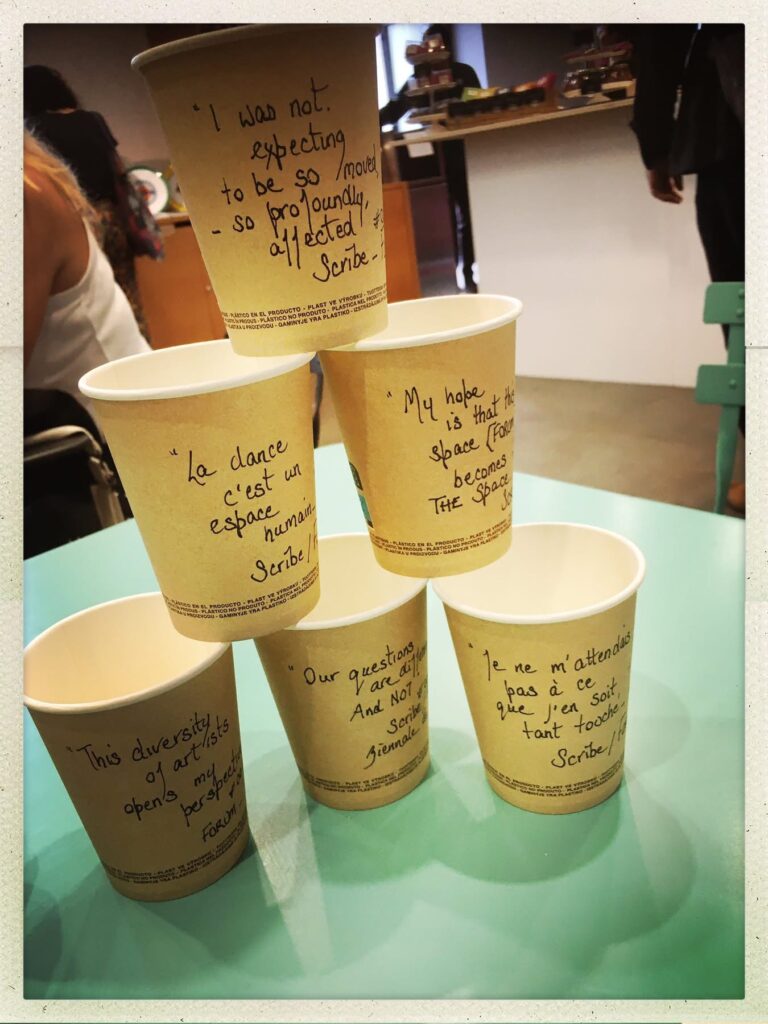
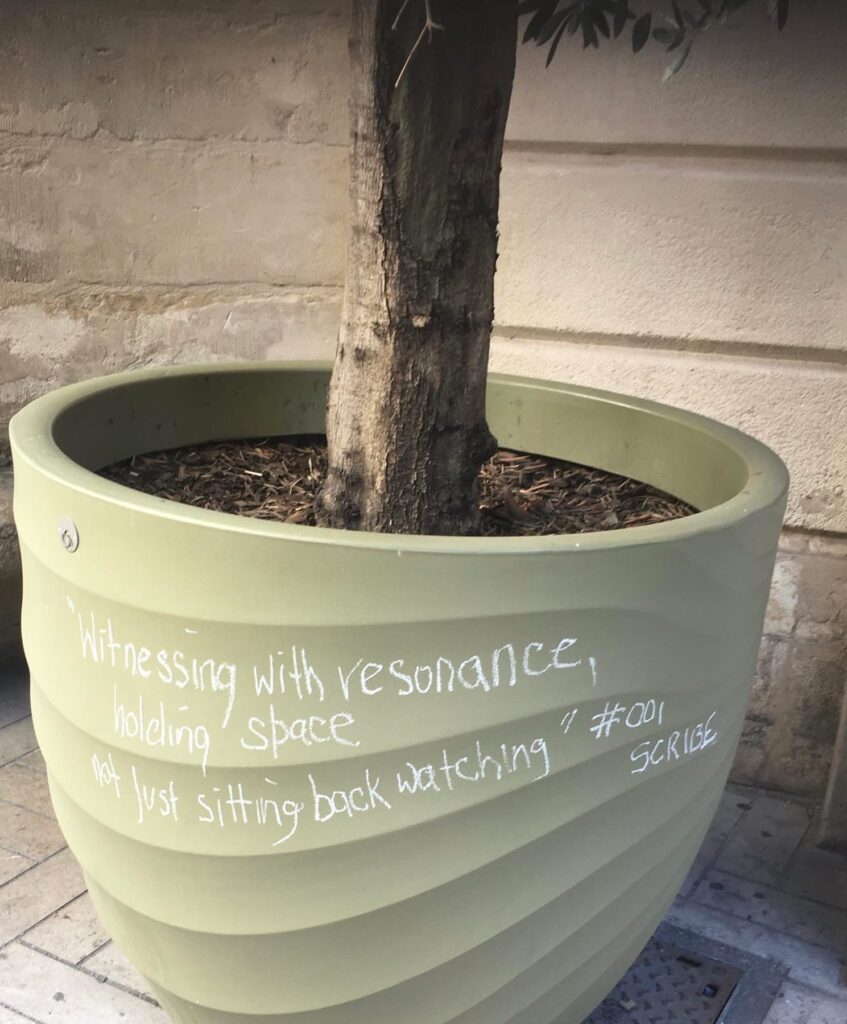
At FORUM, for example, Leisa Shelton proposed “SCRIBE,” a programme where audiences were invited to share with a scribe what they felt, what they retained from the different programs of the FORUM. These scribed experiences accumulated into an “Archive of Affect.” There was also the presence of young critics through Aerowaves’ “Springback Assembly”: they were not positioned as external evaluators, but as young professionals who shared the space, experienced the FORUM and offered critical or poetic reviews of those events. As part of On Record, Marie Glon et Lorena Sajous captured sensations and soundscapes, fragments of conversation from artists, audiences, curators, staff—even security—respectively, now also online as writings and podcasts, all intimate recordings of the FORUM atmosphere.
These kinds of projects are delicate. Precisely because capturing the feel of these experiences as they emerge and before they disappear, we need other methods to grasp presence and sensation. Through these three live-archiving projects, I think we gained something special.
I also feel audiences today have a strong desire to be involved—not only to sit and watch passively. To participate, to witness more actively may itself be what being a “good audience” means now. Perhaps watching itself is already a practice.
And I really want to acknowledge the courage it took for an institution such as the Biennale to place such a project at the heart of its programme, despite the budgetary difficulties. FORUM existed as a slightly special, heterogeneous “other space” within a classical festival structure centred on performances: a place to invent other ways of relating to artists.
©︎ Leisa Shelton
©︎ Leisa Shelton
■ Continuing by drawing a spiral: power and responsibility in curation
— Will FORUM continue?
I think so. The form may vary a little, but the Biennale knows it is a strong offering, worth investing in.
At the end of the programme, the words of our Australian Indigenous spiritual and intellectual leader, June Oscar, sounded so true: “The real work begins now.” In other words, with this first edition we have cracked open something—an opening for another possibility. From here, the work will be how to protect this precious thing and make it stronger and more present in time. If more voices are to be heard, if more audiences are to be invited, we need to keep staying with the questions, rather than moving on.
— Finally, after this experience, what do you feel you want to deepen further?
At the moment, my own doctoral research is on questions like: what does it mean to programme dance? what does it mean to make dance “present”? In English we say “to present dance,” which contains a double meaning: to show dance, and to bring dance into presence here and now. These meanings shift radically depending on context, so there can’t be a simple definition. That’s why understanding our role and responsibility as presenters-curators is always at stake.
FORUM was one of the most complex projects I’ve ever been involved in—in a good way, because it demanded constant attention. I often think of Anne Teresa De Keersmaeker’s words on working with spirals: you spin and spin and when you stop, you are never in the same place as before. For me, FORUM felt very much like that, a constant balancing that keeps you on your toes and asks you to pay attention to these shifts of balance.
If I imagine the project as a diagram: there is first a circle of curators; then the circle expands towards artists; then it opens to audiences. Continuing to expand while keeping the circle intact felt like balancing acts—because I had to continuously attend to hospitality, presence, and attention.
What I realised, in the end, was that this was—very concretely—a practice of hospitality: a space that contains ambiguity and risk, and yet can generate generosity and open possibility. If FORUM truly did this, perhaps this means we attended to this work well.
I’m proud I could be part of this project in two double role —curator and coordinator. This in-between-ness I was in, between artists, my curator colleagues, the Biennale teams, I kept asking myself:
how am I holding this circle? how am I keeping all the balance?
Balancing is not easy. But it is good to keep questioning the kinds of ways of being and relating our “invitations” generate as curators as well as our posture and position. Because we have the power to offer the initial invitation most of the times and it is a double-fold invitation. The act of offering an invitation to artists and audiences carries real force. And that is why a double responsibility emerges.
This experience was so rich that I still don’t have words to express everything that this project has stirred. Yet looking at what happened between artists, and with audiences, and at the response and feedback received afterward, it’s clear the project was a strong experience for many people. That makes me genuinely happy.
And yet: so much more work to do as not everyone was there; not every voice was represented. Even when we say “Europe” we are tempted to speak as if it were a single bloc, when as Eastern Europe and Central Europe hold entirely different histories and realities. The same goes for “Asia.” To lump things together like this is to drop complexity. That’s why, through projects like this, we have to pause and keep asking: who are we speaking about? to whom are we speaking? what responsibility comes with it?
For that reason, managing this type of projects is not easy, and not comfortable. It is always very stressful as you wonder : will it succeed, will it be extra-ordinary or will it be yet another ‘ordinary’ project? Ultimately, I think such projects are a spiral with and within yourself, it is like an ongoing intention of paying attention. It’s a very choreographic process, isn’t it? —and hopefully we also know how to balance.
Overview
Biennale de la danse de Lyon 2025 – FORUM
Dates: 17–21 September 2025
Venue: Cité Internationale de la Gastronomie (Lyon 2)
Admission: Free
Participating Curators × Artists
Australia: Angela Conquet × Marrugeku
Brazil: Nayse Lopez × Original Bomber Crew
Mozambique: Quito Tembe × Idio Chichava
Taiwan: River Lin × Fangas Nayaw
United States: Angela Mattox × devynn emory
Coordination: Angela Conquet
Articles in this series:
Being together, sensing together: on FORUM at the Biennale de la danse de Lyon 2025
Part ①
– Internationality in festivals: between the local and the universal
– Thinking the world through the body: dance beyond “works”
Part ②
– Curating relationships: between artists, and with audiences
– Language as a mirror of other thought, imagination, and bodily systems
– An opening where “sensing together” emerged
Part ③
– Hospitalities: generosity, and the tension it contains
– “What are we calling contemporary dance?”
– Continuing by drawing a spiral: power and responsibility in curation
Interview, Writing & Translation: Yurika Kuremiya
▶︎ 日本語訳はこちらから:
共に在ること、共に感じること —— リヨン・ダンス・ビエンナーレ2025「FORUM」をめぐって
 ©︎ Mathilda Parsons
Angela Conquet アンジェラ・コンケ
Angela Conquet アンジェラ・コンケ
Angela Conquet is an independent dance curator, researcher, writer and translator, working between Europe and Australia. She was Artistic Director of Dancehouse in Melbourne from 2011 to 2020 and of the Keir Choreographic Award and co-director of Dance Massive Festival. More recently, she was the Guest Curator of Dance in Vancouver Festival in 2021, a member of the Asia Network for Dance AND+, and a fellow of the Saison Foundation. Before relocating to Australia in 2011, she was leading the dance artist in residence programs at Mains d’oeuvres in Paris. She has just finalised her doctoral thesis at the University of Melbourne/ UGA Grenoble – with a focus on dance-specific curatorial practices – where she also lectures in Arts Management. She is a co-curator and the coordinator of this edition of FORUM at the Biennale de la danse de Lyon 2025.
ヨーロッパとオーストラリアを拠点に活動する、インディペンデント・ダンス・キュレーター、リサーチャー、ライター、翻訳者。2011年から2020年までメルボルンの〈Dancehouse〉の芸術監督を務めるとともに、〈Keir Choreographic Award〉の芸術監督、〈Dance Massive Festival〉の共同ディレクターを歴任した。近年では、2021年に〈Dance in Vancouver Festival〉のゲスト・キュレーターを務めたほか、〈Asia Network for Dance AND+〉のメンバー、セゾン文化財団ヴィジティング・フェローとしても活動している。2011年にオーストラリアへ拠点を移す以前は、パリの〈Mains d’œuvres〉にてダンス分野のアーティスト・イン・レジデンス・プログラムを主導した。現在は、ダンスに特化したキュラトリアル・プラクティスをテーマに、メルボルン大学/グルノーブル・アルプ大学(UGA)にて博士論文を提出し、同時にアーツ・マネジメント分野で教鞭を執っている。2025年リヨン・ダンス・ビエンナーレにおける「FORUM」では、共同キュレーターおよびコーディネーターを務めた。
記事一覧